
By Tunde Adebayo
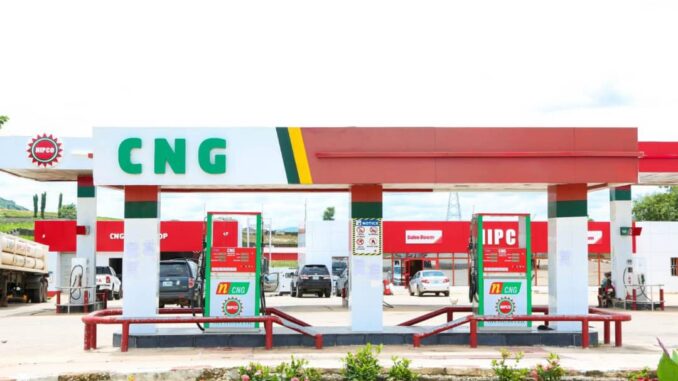
The Federal Government has announced plans to establish 2,322 Compressed Natural Gas (CNG) stations nationwide by 2027, as part of efforts to accelerate the adoption of alternative fuel vehicles and expand gas mobility infrastructure across Nigeria.
Executive Chairman of the Presidential Initiative on Compressed Natural Gas and Electronic Vehicles (PICNG), Ismaeel Ahmed, disclosed this at the Nigerian Oil and Gas Midstream and Downstream Summit organised by the Nigerian Content Development and Monitoring Board in Lagos.
Represented by Olayinka Rufai, Ahmed highlighted the rapid progress made in expanding CNG infrastructure and vehicle conversion in less than three years.
“At inception, only one state had CNG available commercially. Today, 24 states are active, making this one of the fastest expansions globally, especially given our economic conditions,” he said.
Vehicle Conversions and Investments
Ahmed revealed that over 100,000 vehicles have already been converted to run on CNG, with most being commercial vehicles aimed at reducing transportation costs for Nigerians.
He added that the initiative has attracted over $1 billion in investments into the CNG mobility sector, underscoring its potential as a new growth industry.
Infrastructure Expansion
Nigeria currently has 72 active CNG refuelling stations and 175 more under development, alongside 28 compression stations in operation and 65 under construction to support virtual gas pipeline distribution.
Ahmed also noted the establishment of 350 conversion centres nationwide, describing them as small Nigerian businesses driving sectoral growth.
“Whatever number you see today, we expect to triple it in less than 18 months. Once major players join in, retail supply infrastructure will expand even faster,” he said.
Manpower Development
To support the initiative, over 5,600 technicians have been trained and certified in CNG conversion technologies, ensuring mechanics across the country can maintain converted vehicles.
Local Assembly and Cost Advantage
The government has deployed 4,318 CNG tricycles, 95 per cent of which were assembled locally. Ahmed noted that Nigeria is witnessing increased local assembly activities, particularly in tricycles and motorcycles, with Africa’s largest motorcycle assembly plant located in Lagos.
On cost benefits, he stressed that CNG remains significantly cheaper than petrol:
- CNG: N380–N450 per standard cubic metre (equivalent to one litre of petrol).
- Petrol: N1,300–N1,350 per litre.
“The compelling argument is simple. Where would you rather be?” Ahmed asked.
2027 Targets
The initiative’s targets for 2027 include:
- 2,322 CNG stations nationwide
- 3,000 active conversion workshops
- 1,000,000 total vehicle conversions
- 75,000 direct jobs created
- 300,000 indirect jobs generated
Ahmed added that alongside CNG, the government is scaling up electric vehicle (EV) deployment, with pilot EV projects and charging infrastructure planned across the country.