
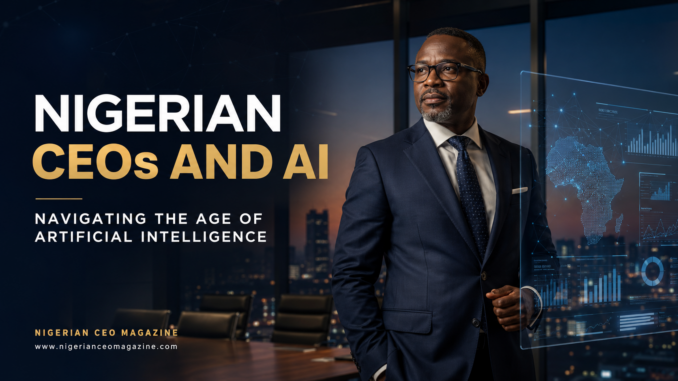
Artificial intelligence is no longer a distant technological possibility. It is already changing how companies operate, compete, communicate with customers and make decisions. For Nigerian CEOs, therefore, the central question is no longer whether AI will affect their organisations, but how quickly and responsibly they can respond.
Across banking, telecommunications, healthcare, manufacturing, energy, retail, media and professional services, AI is creating new possibilities. Companies can use it to analyse large amounts of data, automate repetitive processes, identify risks, improve customer service and develop more personalised products. Generative AI can also support research, marketing, reporting, software development and internal communication.
However, adopting AI does not simply mean subscribing to the latest software. It requires leadership, strategy and institutional readiness.
The CEO must first determine where AI can create genuine value. Organisations should begin with clearly defined business challenges rather than adopting technology because it is fashionable. A bank might use AI to strengthen fraud detection, while a hospital could deploy it to support diagnostic processes. A manufacturing company might apply predictive analytics to equipment maintenance, inventory planning and energy management.
The best approach is to begin with carefully selected pilot projects. These initiatives should have measurable objectives, designated leadership and appropriate safeguards. Successful pilots can then be expanded across the organisation.
Nigeria’s business environment presents distinct opportunities for AI. The country has a large population, an expanding digital economy, a vibrant entrepreneurial culture and significant unmet demand for financial, educational, healthcare and commercial services. AI could help organisations reach underserved communities, reduce operational costs and overcome infrastructure limitations.
Nevertheless, the risks must not be ignored. AI systems can produce inaccurate information, reproduce bias, expose confidential data and create regulatory or reputational problems. CEOs must ensure that human judgement remains central to important decisions.
Data protection is especially critical. Organisations should establish clear policies regarding the information employees may enter into public AI platforms. Customer records, financial information, contracts, trade secrets and personal employee data must be protected.
AI adoption will also affect the workforce. Some responsibilities will be automated, but new roles and capabilities will emerge. Progressive CEOs should invest in reskilling employees instead of treating AI merely as a cost-cutting mechanism. Staff members need training in data literacy, critical thinking, responsible AI use and digital collaboration.
Boards must also participate actively. AI should become part of corporate governance, risk management and strategic planning. Organisations may need an AI steering committee comprising representatives from technology, legal, risk, human resources, operations and business development.
Nigerian CEOs do not need to become programmers. They must, however, understand AI well enough to ask intelligent questions, evaluate investments and recognise potential dangers.
The companies that succeed will not necessarily be those that adopt the most technology. They will be those that combine innovation with sound judgement, ethical leadership and a clear understanding of customer needs.
In the age of AI, standing still is itself a decision—and potentially a costly one. Nigerian CEOs must explore, experiment and learn, but they must do so responsibly. The future belongs to leaders who can transform technological possibility into sustainable organisational value.
*Published by Nigerian CEO Magazine — [www.nigerianceomagazine.com](http://www.nigerianceomagazine.com)*